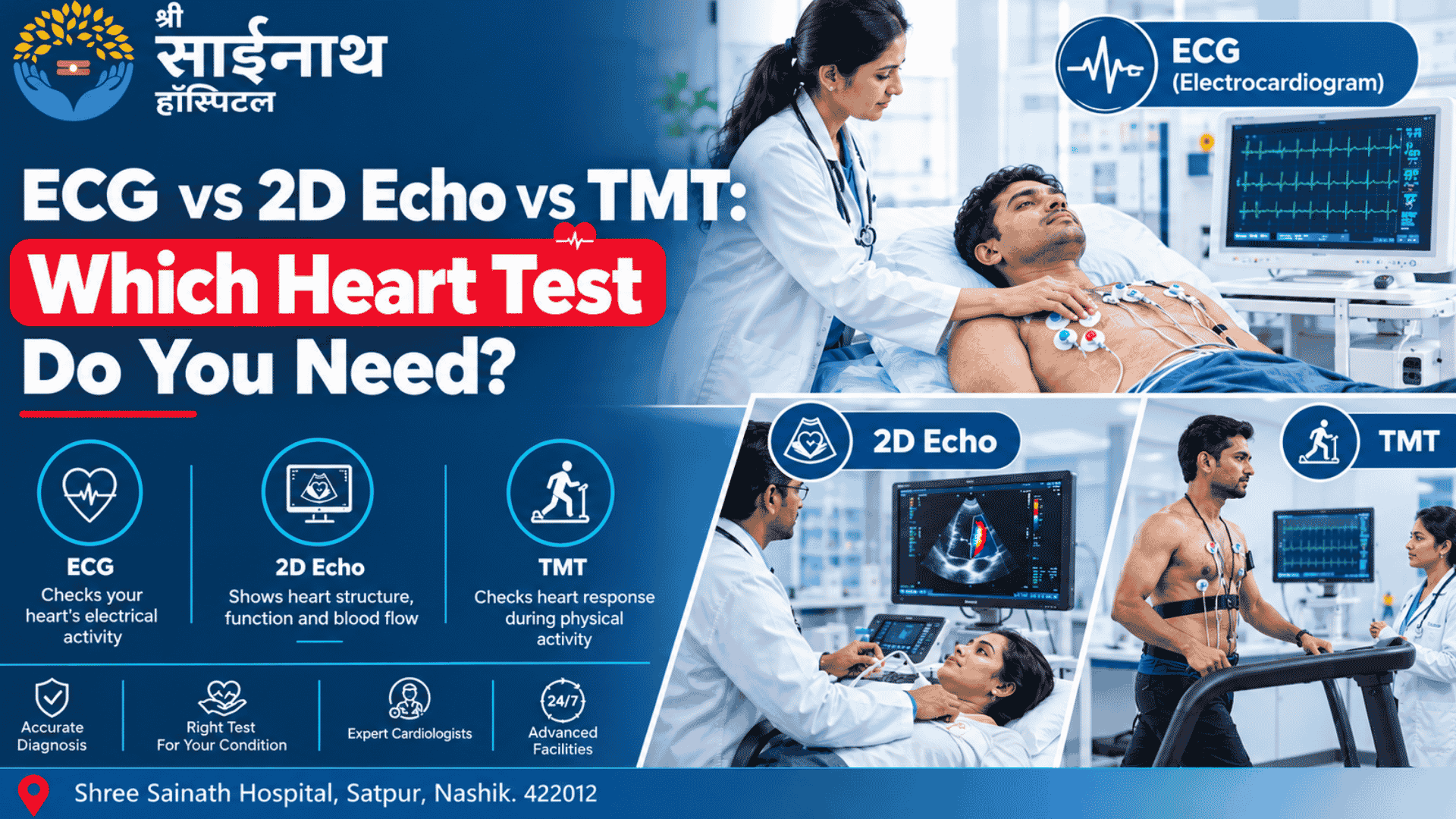
ECG vs 2D Echo vs TMT: Which Heart Test Do You Need?
Your doctor says, “Let’s do an ECG and a 2D Echo,” and then someone adds, “maybe a TMT too.” Three tests, three acronyms, one worried family. Here is how to tell them apart.
An ECG checks your heart’s electrical rhythm. A 2D Echo uses ultrasound to show its structure, valves and pumping strength. A TMT checks how your heart behaves when it works harder. None is better than the others. The right one depends on the question your doctor is trying to answer.
Book a Cardiology Appointment
ECG vs 2D Echo vs TMT: Key Differences
Which test do you need? Start with your situation
Racing, skipping or fluttering heartbeat, dizziness or fainting: an ECG comes first. A short ECG can miss rhythm problems that come and go, so longer monitoring may follow.
Breathlessness, leg swelling or a murmur your doctor heard: a 2D Echo.
Chest discomfort or breathlessness only when you climb stairs or walk fast: a TMT, if your doctor judges it safe.
Chest pain at rest, or with sweating: this is an emergency, not a test appointment. Go to the ER.
No symptoms, just turned 40: you do not need all three. Start with blood pressure, cholesterol and sugar checks. Major guidelines advise against routine ECG or treadmill screening in low-risk adults without symptoms.
What each test feels like
An ECG uses sticky electrodes on your chest, arms and legs. It is painless and takes a few minutes.
A 2D Echo uses a gel and a probe moved over your chest to make moving pictures with sound waves. It is painless and uses no radiation.
For a TMT, you walk on a treadmill that gets faster and steeper in stages while your ECG and blood pressure are watched. The team stops it if you develop symptoms.
What these tests cannot tell you
A normal ECG does not rule out heart disease. It records only the moment you were tested.
A resting Echo does not directly show blockages in the heart arteries.
A TMT suggests reduced blood flow but does not show a blockage itself, and it can be hard to interpret in some people. Imaging such as a stress Echo is sometimes added.
What happens if a test is abnormal?
An abnormal result is a reason to look closer, not a diagnosis. Your cardiologist may repeat or add tests, or advise angiography. Shree Sainath Hospital offers ECG, 2D Echo and TMT, with a cath lab on site if the next step is needed.
When to treat it as an emergency
New chest pressure lasting more than a few minutes, especially with sweating, breathlessness, fainting or pain spreading to the arm, jaw or back, needs emergency care. Call 108 or 112, or our 24x7 emergency line on +91 81808 80975. See our heart attack response page.
Frequently asked questions
Is an ECG better than an Echo?
No. They answer different questions. An ECG checks rhythm and electrical signals, while an Echo shows structure and pumping.
Can a normal ECG hide a heart problem?
Yes. Rhythm problems that come and go, and problems that appear only on exertion, may not show on a short resting ECG.
Can a TMT detect a heart blockage?
Not directly. It can suggest reduced blood flow during exercise. Confirming a blockage needs further tests.
Do I need all three tests?
Usually not. Your cardiologist chooses based on your symptoms, age, risk factors and ability to exercise.
Is a TMT safe and painful?
Stress tests are generally safe. You may feel tired or breathless, and the team monitors you throughout.
Should I take my medicines before a TMT?
Ask your doctor first, because some medicines can affect results. Never stop heart or blood pressure medicines on your own.
Talk to a cardiologist at Shree Sainath Hospital
Not sure which test you need? Bring your reports and symptoms, and we will help you decide. Explore cardiology and heart care or our health checkup plans.