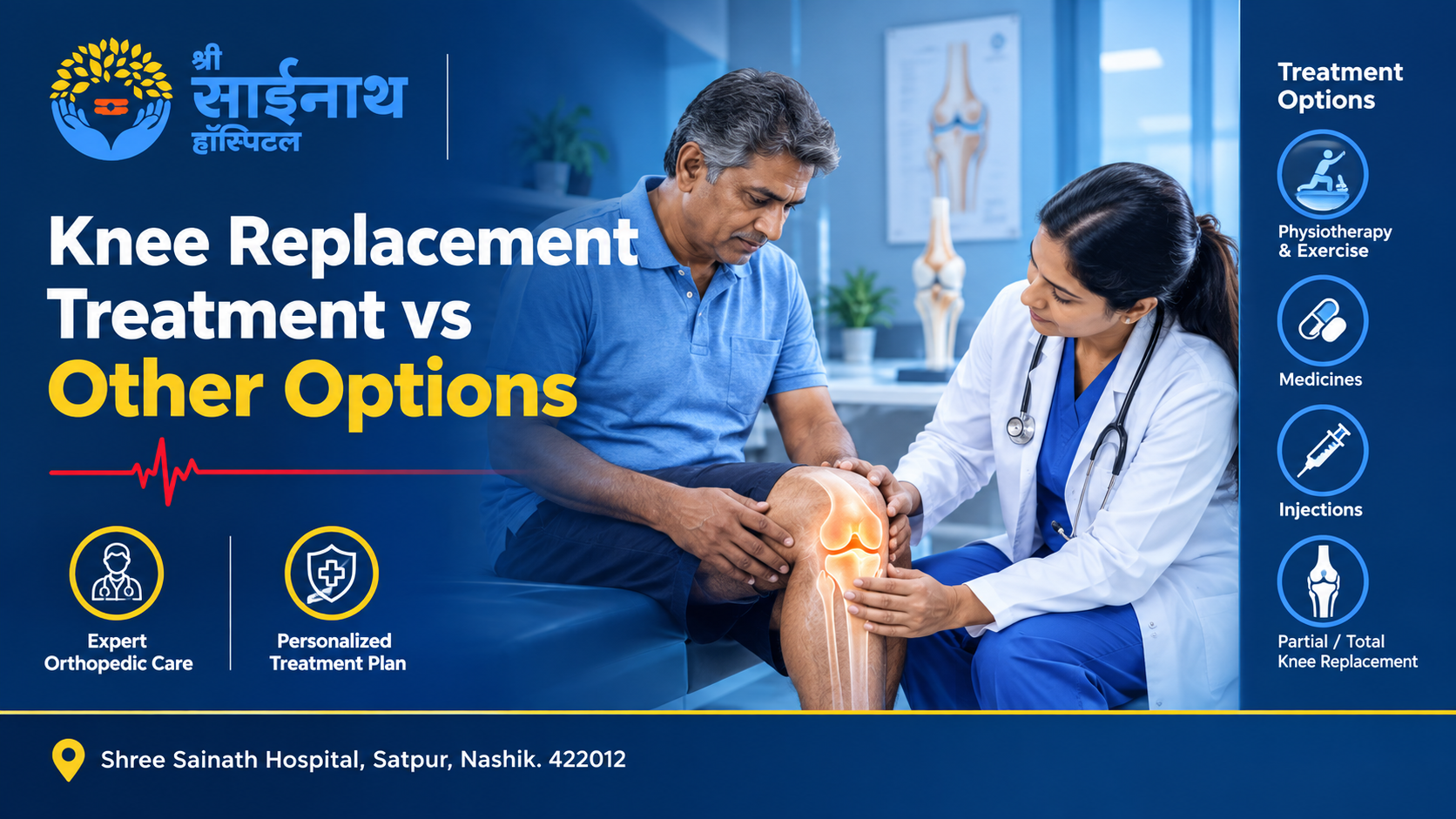
Knee Replacement vs Other Treatments: What Are the Options?
Knee pain can make everyday activities such as walking, climbing stairs, getting up from a chair or standing for long periods increasingly difficult. When knee arthritis becomes more severe, patients often start wondering whether knee replacement treatment is necessary or whether other treatments can provide relief.
The good news is that knee replacement is not automatically the first treatment for every person with knee pain or knee arthritis. Depending on the severity of the condition, symptoms, physical function, medical history and response to earlier treatment, an orthopedic specialist may consider several approaches.
These may include exercise and physiotherapy, lifestyle changes, medicines, selected injections, or surgery such as partial or total knee replacement.
The right treatment should be decided after an individual clinical assessment rather than based only on an X-ray or the severity of pain alone.
Quick Answer: Is Knee Replacement the Only Treatment for Knee Arthritis?
No. Knee replacement is one of several treatment options for knee arthritis.
For many patients, treatment may initially involve non-surgical approaches such as therapeutic exercise, physiotherapy, weight management where appropriate, pain-relief medicines and other supportive measures.
Knee replacement may be considered when symptoms substantially affect quality of life and non-surgical treatment is no longer providing adequate relief or is unsuitable.
The appropriate option depends on the individual patient, the condition of the knee and the goals of treatment.
What Causes the Need for Knee Treatment?
One of the common causes of persistent knee pain is osteoarthritis. It involves progressive changes to the joint that can cause pain, stiffness and reduced function.
Patients may experience:
Knee pain during walking or other activities
Stiffness after periods of rest
Difficulty climbing or descending stairs
Reduced walking distance
Difficulty getting up from a chair
Swelling or tenderness
Reduced knee movement
Increasing difficulty performing everyday activities
However, knee pain does not automatically mean that a person needs knee replacement surgery.
A proper evaluation is important to understand the underlying cause and determine the most suitable treatment.
What Are the Main Knee Pain Treatment Options?
Treatment for knee arthritis can broadly be divided into non-surgical treatment and surgical treatment.
1. Physiotherapy and Therapeutic Exercise
Physiotherapy and appropriately prescribed exercises are important parts of knee arthritis management.
A structured exercise programme may focus on:
Strengthening muscles around the knee
Improving flexibility
Maintaining joint movement
Improving balance and mobility
Supporting everyday physical function
Exercise should be tailored to the individual's condition and ability.
Patients should not assume that complete rest is always the best approach. A specialist or physiotherapist can help determine which activities are appropriate.
2. Lifestyle and Weight Management
For people who are overweight, weight management may form part of knee arthritis treatment.
Reducing excess weight can reduce the load placed on the knee during everyday activities. A suitable combination of physical activity, dietary changes and professional guidance may therefore be recommended where appropriate.
Lifestyle management can also complement other forms of treatment.
3. Medicines for Knee Arthritis
Depending on the individual's medical history and other health conditions, a doctor may recommend medicines to help manage pain and inflammation.
Medication should be selected carefully because not every medicine is suitable for every patient.
Patients should avoid starting long-term pain medicines or anti-inflammatory medicines without appropriate medical advice, particularly if they have other medical conditions or take other medicines.
4. Knee Injections
In some situations, injections may be considered as part of knee pain management.
One commonly discussed option is an intra-articular corticosteroid injection. These injections may provide short-term relief for some patients, but they are not a permanent replacement for treatment of advanced joint damage.
Other injection options, including hyaluronic acid and PRP treatment, may also be discussed by patients. However, their suitability and evidence of benefit can vary, so they should not automatically be considered alternatives to knee replacement.
The decision should be made after discussing the potential benefits, limitations and risks with an orthopedic specialist.
5. Partial Knee Replacement
A partial knee replacement may be an option for selected patients when arthritis is limited to a particular compartment of the knee and the rest of the joint is suitable.
Unlike total knee replacement, partial replacement does not replace the entire knee joint.
Whether partial knee replacement is appropriate depends on the pattern and extent of joint damage, symptoms, examination findings and other clinical factors.
6. Total Knee Replacement
Total knee replacement (TKR) is a surgical treatment in which damaged joint surfaces are replaced with artificial components.
It may be considered when knee arthritis has become sufficiently symptomatic to significantly affect a person's quality of life and appropriate non-surgical treatment has not provided adequate relief.
Total knee replacement is not simply a treatment for an abnormal X-ray. The patient's symptoms, physical function, clinical findings and overall health are important when considering surgery.
Knee Replacement Alternatives vs TKR: What Is the Difference?
This table should not be interpreted as a treatment ladder that applies equally to every patient. Different treatments may be combined, avoided or considered at different stages depending on individual circumstances.
When Is Knee Replacement Needed?
There is no single symptom or X-ray finding that automatically means a patient needs TKR.
Knee replacement may be considered when:
Knee pain is persistent or significantly affects daily life
Mobility and physical function are substantially reduced
Symptoms interfere with sleep, work or routine activities
The underlying joint damage is significant
Appropriate non-surgical treatments have not provided sufficient relief
An orthopedic evaluation indicates that replacement may offer meaningful functional benefit
The decision should be made through discussion between the patient and an orthopedic specialist.
Can Physiotherapy Help Avoid Knee Replacement?
Physiotherapy can help many people manage knee arthritis symptoms and maintain physical function. Strengthening and therapeutic exercise are important components of non-surgical management.
However, physiotherapy cannot reverse advanced structural joint damage.
If symptoms continue to significantly affect quality of life despite appropriate non-surgical treatment, an orthopedic specialist may discuss surgical options.
Therefore, physiotherapy should not be viewed as either a guaranteed way to avoid surgery or as something that becomes unnecessary once surgery is being considered.
What About PRP, Hyaluronic Acid or Other Injections?
Patients often search for injections as an alternative to knee replacement.
It is important to understand that injections are not equivalent to replacing a severely damaged joint.
Corticosteroid injections may provide short-term symptom relief for selected patients. Other injections, such as hyaluronic acid or PRP, may be discussed depending on the individual situation, but evidence and recommendations differ between treatments.
An orthopedic consultation can help determine whether an injection is appropriate or whether another treatment would better match the patient's condition.
Partial vs Total Knee Replacement
The choice between partial and total knee replacement is not simply a matter of choosing the smaller or larger operation.
Partial knee replacement may be considered when arthritis is limited to a suitable part of the knee and the patient meets appropriate clinical criteria.
Total knee replacement may be considered when arthritis affects the knee more extensively.
A detailed orthopedic assessment is therefore important before deciding which surgical option, if any, is appropriate.
How Is the Right Knee Treatment Decided?
An orthopedic specialist may consider several factors, including:
Symptoms – What type of pain or stiffness does the patient experience?
Physical function – How much does the knee problem interfere with daily activities?
Clinical examination – What does the examination show about movement, stability and function?
Medical history – Are there other health conditions that affect treatment choices?
Imaging findings – What do X-rays or other investigations show when clinically required?
Previous treatment – What treatments have already been tried?
Response to treatment – Has conservative treatment provided meaningful relief?
Patient goals – What activities and improvements are important to the patient?
This individualized approach helps distinguish between patients who may continue with non-surgical management and those who may benefit from discussing knee replacement.
When Should You Consult an Orthopedic Specialist?
Consider an orthopedic evaluation if knee pain or stiffness is:
Persistent or progressively worsening
Limiting walking or everyday activities
Making stairs difficult
Affecting sleep or quality of life
Not improving with appropriate conservative treatment
Associated with significant difficulty moving the knee
A specialist can assess the cause of symptoms and explain the available treatment options.
You do not need to decide on knee replacement before the consultation. The purpose of an orthopedic evaluation is to understand the condition and discuss appropriate options.
Questions to Ask Your Orthopedic Specialist
Before deciding on a treatment, patients may find it useful to ask:
What is causing my knee pain?
How advanced is my knee arthritis?
Do I need surgery now?
What non-surgical treatments are appropriate for me?
Could physiotherapy help my symptoms?
Are injections appropriate in my case?
Am I a candidate for partial knee replacement?
Why would total knee replacement be recommended?
What are the expected benefits and risks?
Would a second opinion be useful before surgery?
What would rehabilitation involve after knee replacement?
These questions can help patients understand the reasoning behind a recommended treatment rather than making a decision based only on the procedure name.
Knee Replacement Recovery: What Should Patients Know?
Recovery after knee replacement involves more than the operation itself.
Rehabilitation and gradual mobilization are important parts of postoperative care. A physiotherapy programme may be used to help restore movement, strength and functional mobility.
Recovery differs between individuals and can be influenced by factors such as overall health, physical condition, the type of surgery and adherence to rehabilitation.
Patients should therefore avoid relying on a fixed recovery timeline without discussing their individual situation with their surgical and rehabilitation team.
Shree Sainath Hospital, Satpur, Nashik
For patients dealing with persistent or advanced knee problems, specialist orthopedic evaluation can help clarify whether continued non-surgical treatment, an injection-based approach, partial knee replacement or total knee replacement is appropriate.
At Shree Sainath Hospital, Satpur, Nashik, patients can seek evaluation for orthopedic and joint-related problems as part of the hospital's broader Advanced & Life-Saving Care approach.
The focus should be on understanding the patient's condition, discussing appropriate treatment options and helping the patient make an informed decision in consultation with the treating specialist.
Frequently Asked Questions About Knee Replacement Treatment
1. Is knee replacement the only treatment for knee arthritis?
No. Knee replacement is one of several treatment options for knee arthritis. Depending on the patient's condition, treatment may include physiotherapy, therapeutic exercise, lifestyle and weight management, medicines, selected injections, partial knee replacement or total knee replacement.
2. What are the alternatives to knee replacement?
Knee replacement alternatives may include physiotherapy, therapeutic exercises, weight management where appropriate, medicines and selected knee injections. The suitable option depends on the severity of arthritis, symptoms, physical function, medical history and response to previous treatment.
3. When is knee replacement treatment considered?
Knee replacement may be considered when knee pain significantly affects daily activities or quality of life, physical function is substantially reduced, joint damage is significant, and appropriate non-surgical treatments have not provided sufficient relief. An orthopedic specialist should assess whether replacement is appropriate.
4. Can physiotherapy help with knee arthritis?
Yes. Physiotherapy and appropriately prescribed exercises can help manage knee arthritis symptoms and support strength, flexibility, movement, balance and mobility. However, physiotherapy cannot reverse advanced structural joint damage.
5. Are knee injections an alternative to knee replacement?
Knee injections may be considered for selected patients as part of knee pain management. Corticosteroid injections may provide short-term symptom relief for some patients. Hyaluronic acid and PRP injections may also be discussed, but their suitability and evidence of benefit can vary. They should not automatically be considered equivalent alternatives to knee replacement.
6. What is the difference between partial and total knee replacement?
Partial knee replacement replaces a damaged section of the knee and may be considered when arthritis is limited to a suitable part of the joint. Total knee replacement replaces damaged joint surfaces with artificial components and may be considered when arthritis affects the knee more extensively.
7. How is the right knee treatment decided?
An orthopedic specialist may consider symptoms, physical function, clinical examination, medical history, imaging findings, previous treatments, response to treatment and the patient's goals. Treatment should be individualized rather than based only on an X-ray or pain severity.
8. Should I see an orthopedic specialist before deciding on knee replacement?
Yes. An orthopedic evaluation can help identify the cause of knee symptoms and explain appropriate treatment options. You do not need to decide on knee replacement before the consultation. The specialist can discuss whether conservative treatment, injections, partial knee replacement or total knee replacement may be appropriate.
Final Takeaway
Knee replacement treatment is not the only option for knee arthritis.
Depending on the condition, patients may benefit from physiotherapy, therapeutic exercise, lifestyle changes, medicines, selected injections or other treatments.
For patients with advanced symptoms that substantially affect quality of life and do not respond adequately to appropriate non-surgical treatment, knee replacement may become an important treatment option.
The key is not to ask only:
“Do I need knee replacement?”
A more useful question is:
“What treatment is appropriate for the condition of my knee, my symptoms and my daily needs?”
An orthopedic consultation can help answer that question and explain whether conservative treatment, partial knee replacement or total knee replacement is appropriate.
Conclusion
Discuss your knee symptoms, reports and treatment options with an orthopedic specialist at Shree Sainath Hospital, Satpur, Nashik.